
Cross-border operational due diligence for private equity
The cross-border risks your diligence model can’t see.
Cross-border costs hide inside margin and surface after close. We find them in diligence, size them for your deal model, and fix them before they compound.
- i.Operator-led, senior on every engagement
- ii.Independent of carriers, brokers and forwarders
- iii.Confidential by default, NDA first
- iv.Worldwide, through a long-standing network
01The problem in under a minute
Made in Europe, stored in the US, sold back to Europe. Paid for twice.
One central warehouse feels efficient from inside the business. Trace each order against where its customer sits, and the round trip appears: freight twice, duty often twice. It’s one of the costs a standard review misses.
02Why it happens
Logistics gets treated as a department. It is an operation.
The people who choose suppliers, set terms and sign contracts rarely see what those decisions cost to move. Founder- and family-owned companies often grew without institutional trade compliance, and the cost sits quietly inside COGS, freight and lost duties.
Where the cost hidesThe data room shows
- Revenue
- Gross margin
- EBITDA
- Customer concentration
- Headcount
It doesn’t show
- Freight leakage
- Broker fees and surcharges
- Duty and tariff exposure
- Classification and origin errors
- Paperwork built by hand
03When to call us
Call us before you sign if the company you’re buying…
These are the signs that cross-border cost and risk are sitting inside the numbers. We’ve dealt with every one of them first-hand.
Makes or buys overseas
A real share of what it sells crosses a border on the way in.
Sells abroad
Into the UK, EU, Canada, Mexico or wherever else it ships, direct or through resellers.
Sends goods the long way
A US warehouse filling orders for customers overseas.
Buys Ex Works
It owns export and import formalities, and the risk the whole way, often without knowing it.
Can’t say who holds what
No clear owner of the goods, the risk or the liability at each handoff.
Runs on an ERP alone
No transportation or warehouse system, so nobody sees how goods actually move.
Trusts codes nobody checked
Tariff codes and origin left to a broker or an automated tool.
Signs terms without logistics
Sales or purchasing sets shipping terms with no one from logistics in the room.
The moments to call
- Before LOIA quick screen from the CIM and a call with management tells you whether to price it in.
- During exclusivityA full assessment in three weeks fits inside the window.
- Before an add-onTwo companies’ freight, brokers and paperwork have to become one.
- When a tariff hitsWhat it costs a portfolio company, and what can be moved or reclaimed.
- A year before exitClean records, so the next buyer doesn’t take it off the price.
04From our leadership’s operating experience
The round trip nobody could see.
A luxury home goods brand bought from makers in Europe and sold to customers in Europe. Many of those orders crossed the Atlantic twice.
What happened
The vendors sold Ex Works, so the company controlled the freight from the maker’s door. Shipping direct to a European customer meant extra paperwork and setup no one had built. So the goods went to the US warehouse, got received, and shipped back out as a new order.
Nobody flagged it. With an ERP and no transportation or warehouse system, finance saw an import and, weeks later, an export. Each looked normal. Together they meant freight both ways, US duty on the way in, and duty and VAT again on the way back.
We saw it in a less obvious form too. A US customer bought goods to be delivered from a maker in France to a site in Switzerland, a short truck ride. Because the buyer was American, the order was folded into the regular shipment to the US and sent back across the Atlantic.
What we changed
We built new ocean and air routes, a European freight rate table so orders could ship straight from the maker, direct shipping from the maker to customers in the UAE and other markets, and white-glove delivery from the maker to customers in the US. European orders stopped crossing the Atlantic twice.
When a company makes and sells outside the US, ask why the goods pass through a US warehouse.
05Where we fit
From diligence to exit, one firm across the whole chain.
Many deal teams hire a freight auditor, a customs broker, a consultancy and an operating partner, then reconcile four reports. We cover freight, paperwork, tariffs, systems and border logistics in one view, and stay to implement.
Pre-deal Cross-Border Diligence
The cross-border cost and risk behind the numbers, sized and tied to valuation and deal terms.
100-Day Plan
The fixes that recover cost after close, in priority order with owners and dates.
Operating Partner on Demand
Ongoing oversight of vendors, tariffs and cross-border cost across the portfolio.
Exit Readiness
Audit-ready records and a documented, defensible cross-border story for the next buyer.
Recover margin
Freight, fees, duties and rework.
Reduce exposure
Compliance, tariff and supply risk.
Strengthen exit
Clean, documented, audit-ready.
06What you receive
Not a binder. A clear read on the deal.
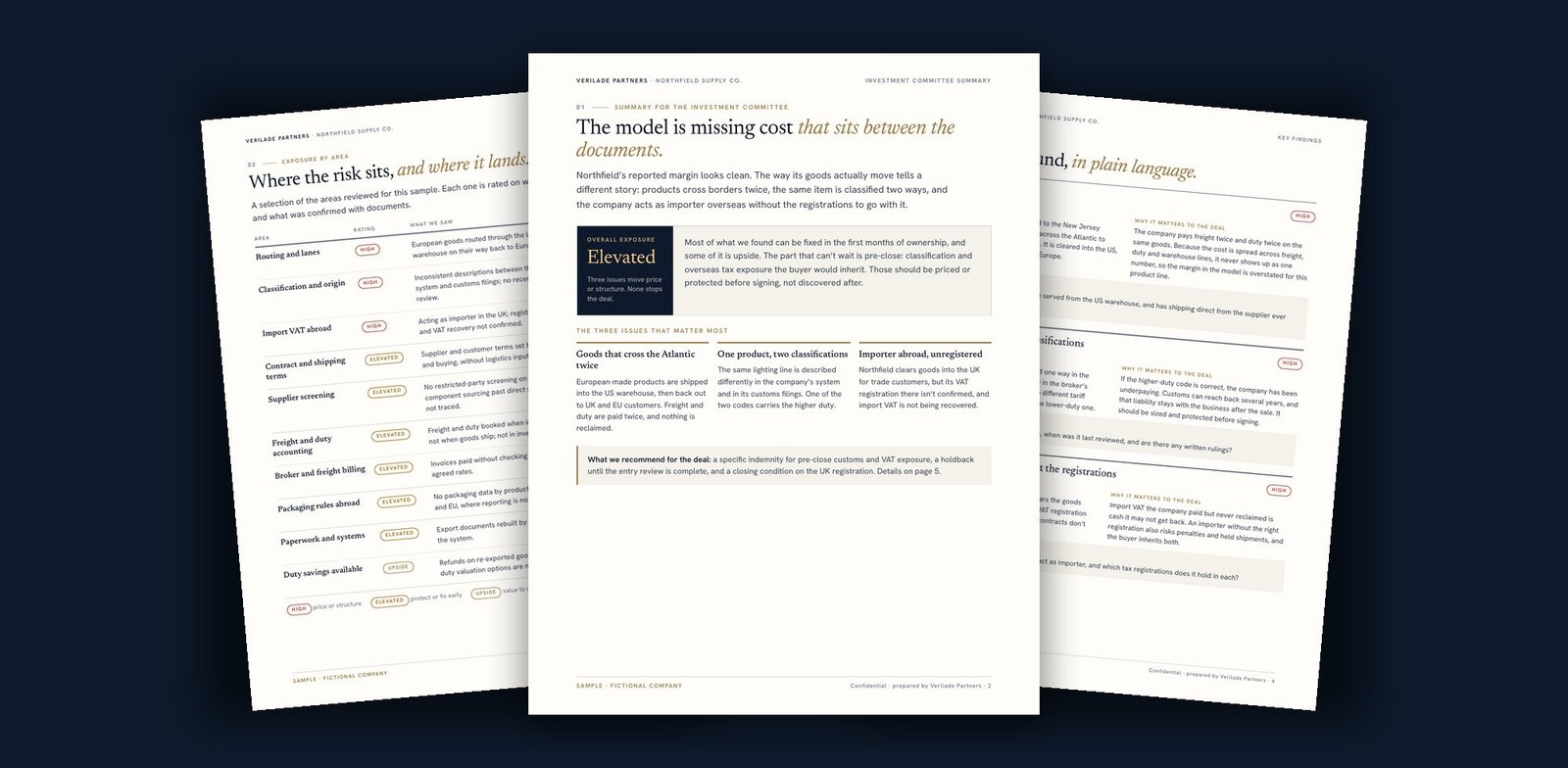
Every engagement follows the Verilade Framework, built from running these operations, so every deal is measured the same way. Your deal team gets exposure by area, where product actually moves, what each finding means for price and terms, and a plan to follow after close.
Exposure summary
Overall exposure, committee flags and protections to negotiate, scored across every cross-border area.
Global lanes
Where the company buys and sells, with round trips and pass-through routing flagged on the map.
Findings in plain language
What we see, why it matters to the deal, and what to ask management.
100-day tracker
Every fix becomes a dated step with an owner, so value capture starts at close.

07Who leads the work
Operator-led. We’ve run the businesses you’re buying.
Our leadership has built international logistics and compliance infrastructure, owned the P&L of an import and distribution business, and run multi-shift operations. That is why we know where cross-border problems hide: terms no one questions, paperwork rebuilt by hand, fees left unnegotiated, and handoffs with no clear owner.
Justin Young, MBAManaging Partner · leads every engagement
Start a conversation
Find out what your target’s freight and paperwork are hiding.
Start with a confidential Cross-Border Exposure Screen on one deal or one portfolio company. Scoped to your deal timeline.